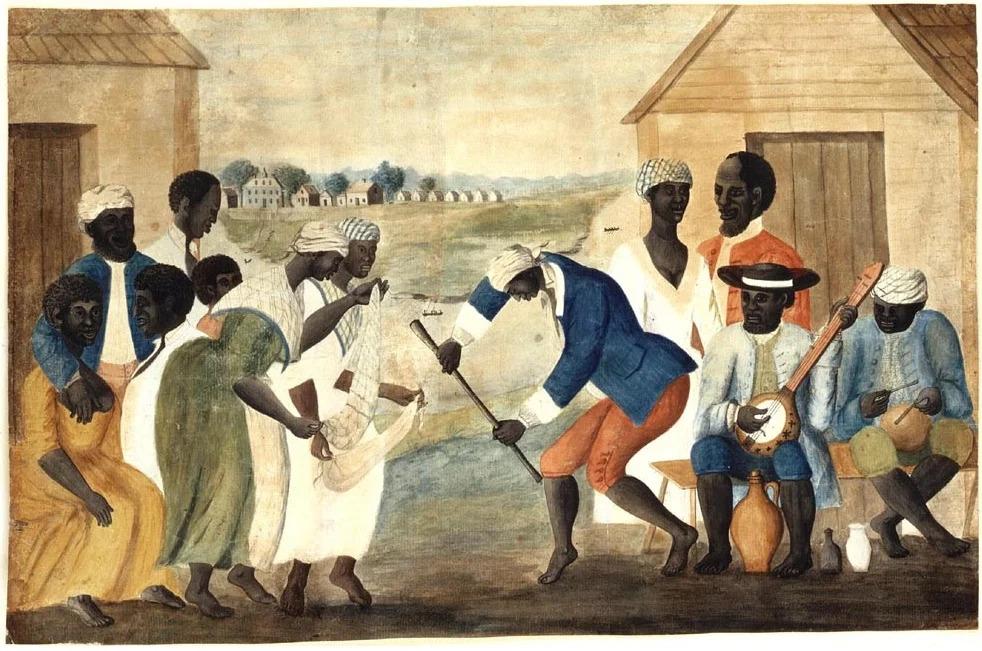
If you've ever considered banjo music to be an American creation, you don't know the banjo. In fact, if you think of the banjo as an inherently Southern instrument, you don't know the banjo. If you think that the banjo can teach us nothing about American history, Southern culture and modern race relations, then you certainly don't know the banjo.
And you’ve probably never heard the Carolina Chocolate Drops.
For those of you like me who are not formally trained musicologists, here's a super-quick summation of the first 400 years of banjo history:
1) The handmade gourd instruments that would become the modern banjo originated in West Africa. 2) Enslaved Africans carried the “banjar” and its music to North America by way of the Caribbean. 3) Traditional string music (and the banjo itself) was appropriated from slave culture and was spread into the greater American popular culture through minstrel shows and blackface performances. And 4) the banjo was popularized throughout the United States and Europe by white performers, with various regional playing styles emerging and evolving simultaneously – from the rhythmic role the banjo played in traditional New Orleans jazz to the fingerpicking sound of bluegrass that bloomed in the Appalachian mountains, among many others.
In short, we owe the banjo's modern presence in America to Africans who were brought here against their will. Thus has the banjo become like okra, an undeserved gift to all parts of Southern culture, but one that came only from the people our ancestors enslaved.
If any of this is news to you, welcome to the club.
In the last five years, pop music has become a proverbial breeding ground for a not-quite-folk "revival" of sorts, with traditional string instruments being wielded in a way that is — intentionally or not — devoid of much historical context. Bands like Mumford & Sons have reintroduced and redefined the banjo to a new generation of listeners, but without drawing clear lines to deeper musical traditions.
Meanwhile, the once-country star Taylor Swift — the same one who passionately strummed her banjo onstage at the Grammy Awards just three years ago — has unapologetically traded in her five-string for an electronic beat machine on her latest album, “1989.” The fact that this drastic interchange was so easily achieved and widely unquestioned points toward the expendability of the banjo in pop music today.
We're seeing more banjos than we have in years, but the instrument seems more of a novel accessory than a necessity to many artists.
With its mixed bag of presentations in today’s popular music, it's easy to see how the banjo is suffering from an incredibly vast identity crisis. In this era of "fauxlk" music, [quite literally "faux-folk" music], the true origins of the banjo get lost in the broad sweep of popular culture.
But if we wind back the clock and parse out the pieces of the banjo's history that have been widely forgotten, the result is a fascinating picture of America (and, specifically, of the South) that can teach us incredible things about ourselves and provide a stepping stone to a greater understanding of one another.
Thankfully, the Carolina Chocolate Drops are here to help us out.