Beyoncé's surprise new country album has kicked open the saloon doors to a new audience.
While this may not be Beyoncé's first rodeo when it comes to country music, people are now exploring the genre through her two new songs "16 Carriages" and "Texas Hold 'Em." The latter is a banjo-heavy ode to the singer's home state of Texas, and seems to be already causing controversy due to an Oklahoma country music station refusing a request to play the song because Beyoncé is not traditionally seen as a country artist. The station reneged eventually caved after receiving backlash from Beyoncé's unrelenting fans, but the incident has shed light on the larger misunderstanding of country music's origins.
The banjo's history within roots music is as loaded and complex as the U.S.' relationship with race because they are both inextricably intertwined.
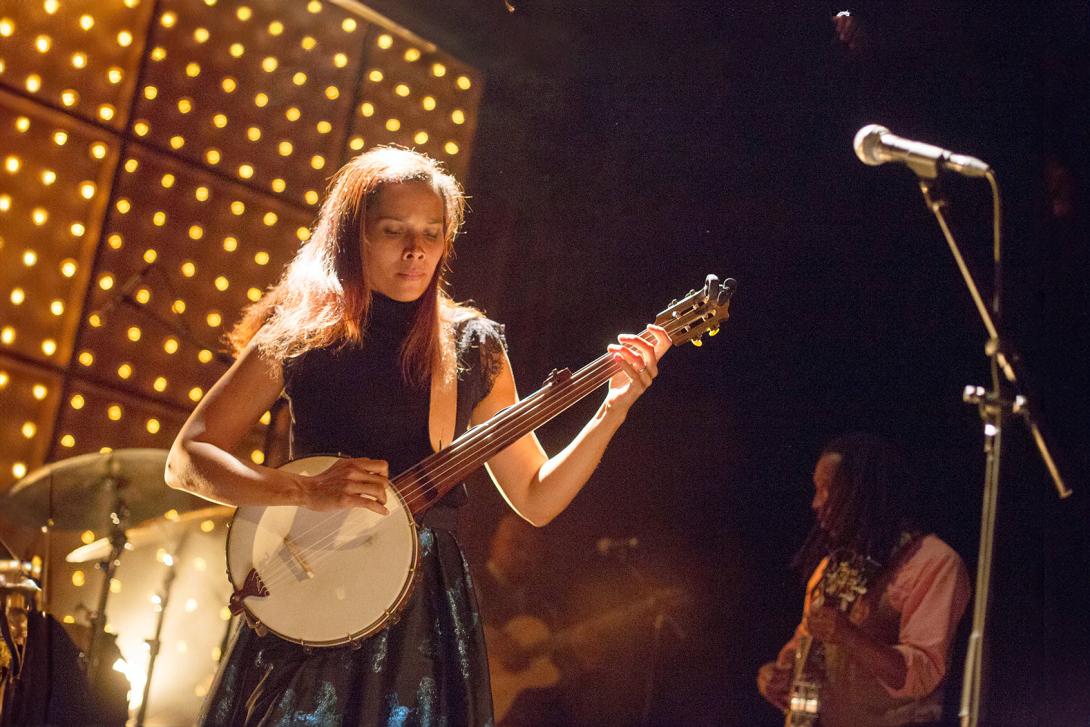
In the song "Texas Hold 'Em," Beyoncé features live banjo and viola playing by Black country musician Rhiannon Giddens, who has been credited for highlighting that Black people created and played the banjo before it was popularized and appropriated by white country artists. So, there's no way to confuse Beyoncé's new era as anything but country especially if songs like "Texas Hold 'Em" heavily feature a historically Black southern instrument like the banjo.
However, the banjo's history within roots music is as loaded and complex as the U.S.' relationship with race because they are both inextricably intertwined. Long before the banjo was considered a staple instrument in mainstream country music, it went through several iterations, but it always had been deeply connected to the Black experience
African lutes, the banjo's predecessor, were documented to be used in early 16th century West Africa in countries such Gambia, Senegal and Guinea-Bissau. Still used today by West Africans, the instrument's main parts are a gourd, and a stick attachment and a bridge for its three to four strings, paralleling a modern banjo. It is also tuned just like a banjo and similarly played by hand, The Black Music Project reported.
At the height of the transatlantic slave trade, abducted Africans were brought to the Caribbean islands first before they were forcibly taken to the American South. It's in these two regions where enslaved people created iterations of instruments that mimicked the ones in their native land to keep the tradition alive during the brutality and subjugation of slavery, The Smithsonian said. Early versions of the banjo were reportedly used in Jamaica in 1687.
Despite the horrific and complex system of slave labor camps, plantations and rural and urban settings — enslaved Africans musical traditions and instruments were upheld and passed down by generations. However, the banjo's creation eventually became a blending between West African and European traditions mostly due to minstrel shows in the 1800s. The instrument was first reported in the U.S. in 1736 and eventually by the 1800s it had its way to New England.