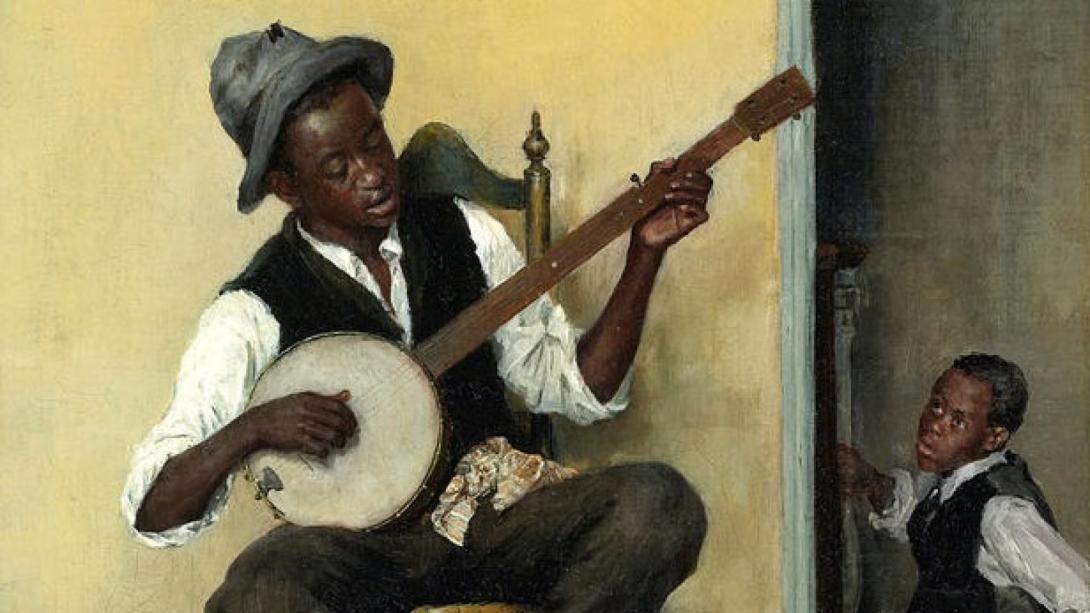
Early American banjo music is Black music. The banjo was created by enslaved African Americans, and according to the Smithsonian Institute, up until the 1830s, the banjo was exclusively an African American tradition. Banjo history has since been colonized and rewritten, but today, an increasingly growing number of people are ushering in a Black banjo revival.
The banjo is a time machine. For centuries before colonialism, its music connected our ancestors to place, history, and heritage. This can also be seen in the banjo’s role as a storytelling tool, its tunes often accompanying oral histories as they were passed down through generations. Later, it connected people who were stolen from Africa back to their roots and to their forebears. It was a slice of freedom for enslaved African Americans, a source of respite and resistance from the brutalities of slavery. Today, it still offers a sense of connection that transcends time and place.
But how do we contextualize this spiritual and material culture of the banjo? Black String Theory helps offer a foundation for that understanding. Ultimately, for Black communities in Africa and across the diaspora, music has never been about commodification, but about community.
“We have to first look at our family histories and understand that music has always been rooted in ceremony and spirit,” says folklorist, educator, and musician Sulé Greg C. Wilson. “Even the most ‘get down’ party is still a ritual and a ceremony. When our ancestors created their own music, everyone had the right and the opportunity to be part of that, and be part of the musical community.” Wilson notes that, in Black cultures, there traditionally is no separation between the sacred and the secular. “When you’re making music, you are bringing community together. You are bringing spirit down. You are conjoining the present, the ancestors, and the future. And so, Black String Theory puts our cultural instruments into a historical and futurist perspective.”