Anthology Introduction
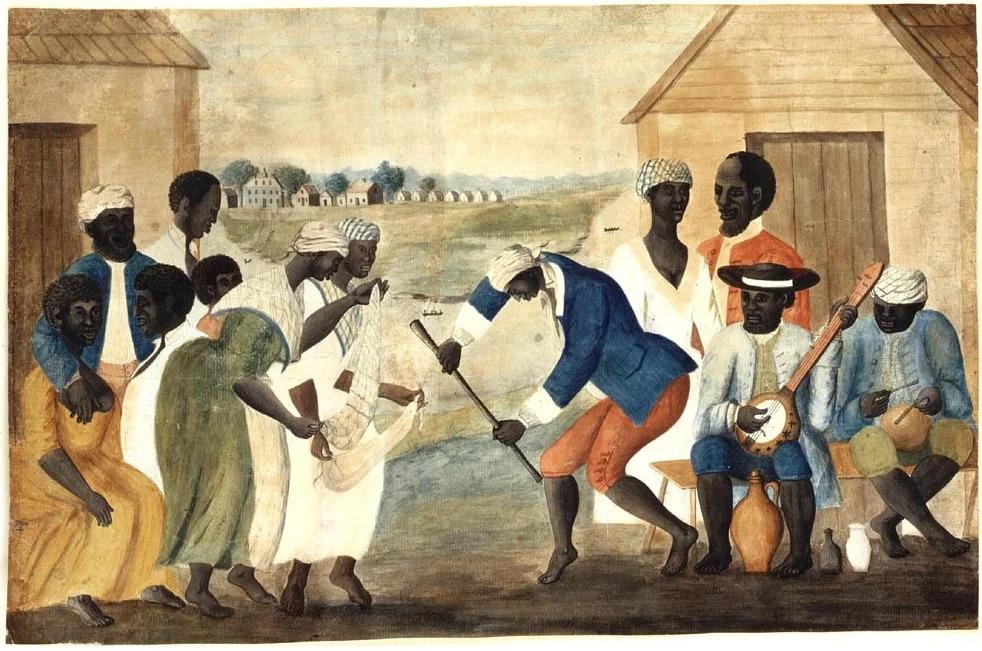
This blog post will be the first in a continuing series that dives into the origins and impacts of specific instruments used in West Virginia’s music today. Beginning our journey with the banjo, the continuing anthology will focus on important instruments in old time, bluegrass, blues, gospel, and other genres through the words of experts, Augusta Archive recordings, and historical images. The banjo is one of the most iconic pieces of American culture and folk music. It is easily recognized around the world by its image, sound, and association with genres such as old time and bluegrass. In this first part of the history and impacts of the banjo, I will look into the instrument’s African origins and its development throughout colonial history and slavery leading up to the mid-nineteenth century, where the banjo began to enter white popular culture.
Early Records of Instruments Resembling the Banjo
The banjo as an instrument can be traced back to instruments brought or made by enslaved people from West Africa to colonies across the Americas. The instrument we think of today looked very different from the many stringed instruments that could have merged to form the modern banjo over centuries. Historian Kristina Gaddy writes in her book, Well of Souls, “Only three early gourd-bodied, African american-made banjos exist today…Known images of the banjo before 1820 number less than fifteen” (Gaddy 2022:xiv). The oldest surviving appearance of an instrument resembling the banjo was drawn by Sir Hans Sloane, a British naturalist and physician in Jamaica, who later went on to found the British Museum. Here he drew two stringed, gourd-bodied instruments, which he called “Strum Strumps” around 1687-1689 (Gaddy 2022: 15).
The early origins of the banjo can be traced back to several different names and African tribes that all had similar looking instruments. “The banjo, as we know it today, bears some resemblance to the Sengalese xalam, the West African molo, and the nkoni of the Manding peoples. All are plucked instruments with a gourd body and shortened fourth string. Unlike those instruments, however, the banjo–which first took such names as banza, banja, and bandore–has a flattened fingerboard, reflecting the simultaneous introduction of European instruments, such as the guitar and mandolin, into North America” (Mazow 2005:2). The banjo is an instrument developed out of Creolization, spiritual resistance, and centuries of blending and mutation. It stands as a symbol of the African cultures that were forced to bend and break under the thumb of slavery in the Americas and the Caribbean.
Confusion On The Term Banjo
Tracing the word banjo, when it is referring to the instrument has always been a difficult and often contentious task. Art historian Leo Mazow points out in his 2005 book, Picturing the Banjo, that “The name of the instrument derived from an African term; in the Caribbean, it was known as banza (Martinique), banjil (Barbados), banshaw (St. Kitts), and bonja (Jamaica). The name appears as bangio in South Carolina and banjou in Philadelphia as early as 1749. It probably evolved from the Kimbundu mbanza, a plucked string instrument constructed of a gourd, tanned skins, and hemp or gut strings.” (Mazow 2005:146). This, however, is not the only theory of where the word comes from. Historian Kristina Gaddy posits that the etymological origin of the word banya, which turned into banjo/banjer, wasn’t a word for the gourd instrument, but for an entire spiritual dance and ritual that happened to often involve the banjo’s predecessor (gourd-bodied instruments) and other instruments, the Banyaprei (or Banya play).